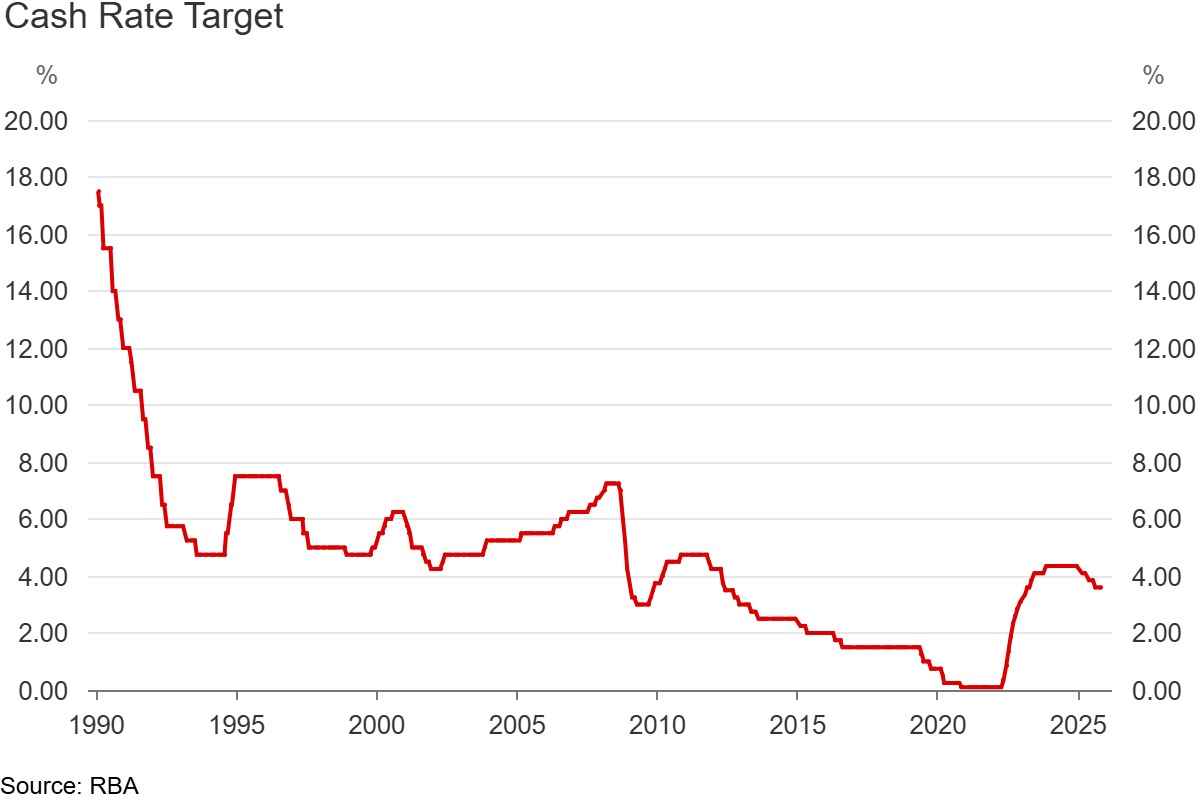
The Reserve Bank of Australia (RBA) has left the cash rate target unchanged at 3.60% in its final monetary policy board meeting for 2025. This comes after higher than expected inflation figures in both the monthly and quarterly prints. Looking ahead into 2026, there are some forecasters who are predicting that the next move could be hike rather than a fall. Speaking at the Press Conference, the RBA Governor Michelle Bullock said “I don’t think there is rate cuts for the foreseeable future”.
The Governing Council of the European Central Bank (ECB) left three key ECB interest rates constant. ECB has three key policy rates namely interest rates on deposit facility, main refinancing operations and marginal lending facility which are left unchanged at 2.00%, 2.15% and 2.40% respectively. The Central Bank has assessed that the current rates are balanced enough to stabilize the inflation level to remain at its 2% target over the medium term time horizon. Speaking to the Press Conference, the head of ECB Christine Lagarde reaffirmed that the council will follow a data-dependent and meeting-by-meeting approach to decide the stance of monetary policy.
The Reserve Bank of New Zealand (RBNZ) has decreased its Official Cash Rate (OCR) by 25 basis points to 2.25% as a final move of 2025. The monetary policy committee mentioned that there is sufficient spare capacity in the kiwi economy to let the inflation fall sustainably towards 2% by mid-2026. The committee is cautious that higher inflation could dampen the economic growth and recovery while maintaining a data-dependent approach to future movements in the official cash rate.
In the United States of America, the Federal Reserve Board (FED) decreased the federal funds rate by 25 basis points to 3.50% – 3.75% range. The Federal Reserve FOMC statement mentions that the inflation level stills remains somewhat elevated while also acknowledges that unemployment rate has risen through September. The committee noted that they are very serious about its dual mandate to promote stable prices and maximum employment and acknowledged that the economic uncertainty has posed risk to both these sides. The committee seems in no rush to make a decision regarding the implication of tariffs on inflation and somewhat thinks that the tariff induced price rise could be just one off and not sticky inflation but is in no mood to give any forward guidance.
Similar to the US, The Monetary Policy Committee (MPC) of the Bank of England (BOE) decided to decrease the Bank Rate by 0.25%, bringing the official policy rate to 3.75%. The Committee acknowledged that the inflation has decreased drastically from its level of around 10% from three years to the latest print of 3.2%. Although the current level is still higher than its target of 2%, it expects the price levels to decrease faster in the future possibly due to the lag effects of its restrictive monetary policy for the last few years.

https://www.rba.gov.au/media-releases/2025/mr-25-33.html
https://www.ecb.europa.eu/press/pr/date/2025/html/ecb.mp251218~58b0e415a6.en.html
https://www.rbnz.govt.nz/hub/news/2025/11/ocr-lowered-to-2-25-percent
https://www.federalreserve.gov/newsevents/pressreleases/monetary20251210a.htm
https://www.bankofengland.co.uk/monetary-policy/the-interest-rate-bank-rate